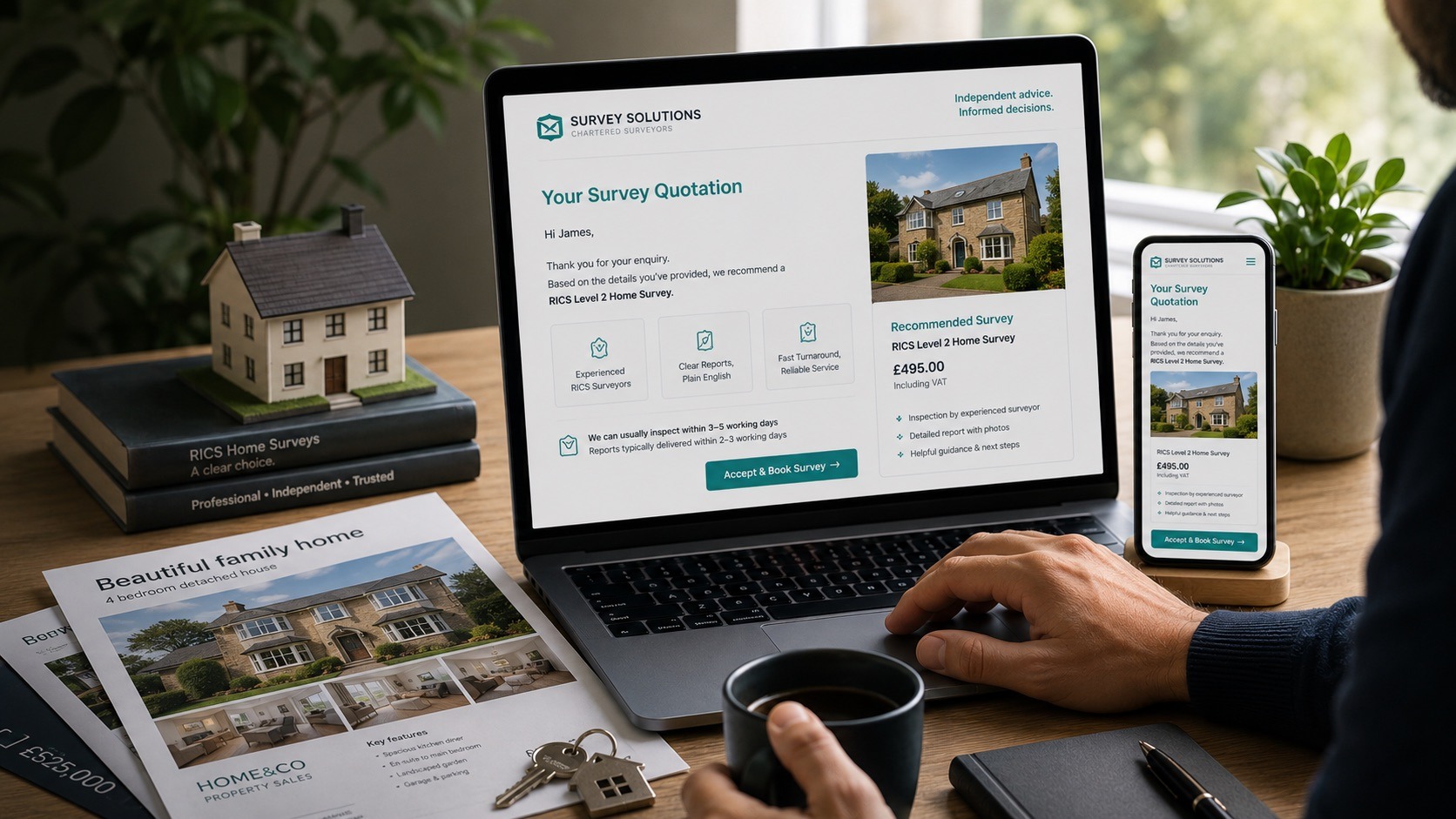
Your Emails Are Selling
Before You Are
Why what you say, how you present it and when you send it can influence the customer decision.
Surveying is a people business.
Customers ultimately instruct a surveyor for their professional expertise, judgement and advice. But increasingly, a significant part of the decision about which surveyor to instruct can happen before the customer has spoken to one at all.
An enquiry is submitted.
An acknowledgement arrives.
A quotation follows.
Perhaps there is a follow-up.
The customer may visit your website, read your reviews and compare your response with two or three other surveying firms.
And throughout that process, your emails are quietly communicating far more than the words written inside them.
They are communicating how organised you appear. How easy you are to deal with. How clearly you explain your service. How much attention you give to detail. How quickly you respond. And, ultimately, how much confidence a customer feels about placing one of the biggest purchasing decisions of their life in your hands.
Your emails are not simply carrying information. They are part of the experience you are selling.
The customer has already changed
In our recent article, The Modern Property Customer: What Today’s Buyers Really Expect, we looked at how property customers are researching more, comparing more and bringing expectations formed elsewhere in their digital lives into the property transaction.
That has important implications for surveying firms.
A quotation email may not be arriving in isolation.
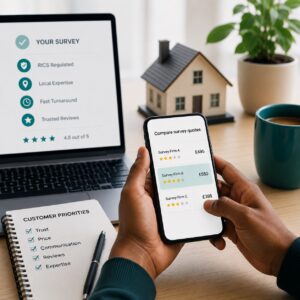
The customer could have your email open alongside another surveyor’s quotation, Google reviews, a comparison website and information explaining the differences between a Level 2 and Level 3 survey.
They are comparing price, certainly.
But they are also comparing confidence.
Before customers can judge the quality of your survey, they are already judging the quality of your communication.
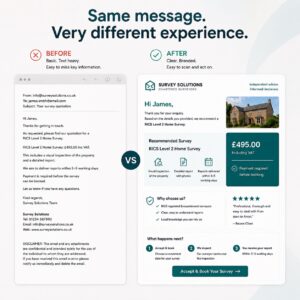
Same firm. Same survey. Same price. Different experience.
Imagine two surveying firms offering the same service at the same price.
One sends:
Hi James,
Thanks for your enquiry. A Level 2 Survey will be £495 inc VAT.
Please let us know if you would like to proceed.
Kind regards.
There is nothing technically wrong with that email.
The other communicates exactly the same £495 fee but also makes it immediately clear which survey is recommended and why, what is included, who will carry it out, when the inspection can take place, when the report is likely to arrive and what the customer needs to do next.
The technical competence of the two surveyors could be identical.
But the customer cannot see that yet.
They can see the communication.
Good email design starts with what you need to say
It is tempting when talking about email design to immediately discuss HTML, colours, images, buttons and branding.
But none of those things can rescue a poor message.
Before asking what an email should look like, it is worth asking what the customer needs it to do.
Good communication makes those answers easy to find.
Poor communication makes the customer work for them.
Property is already a complicated purchasing environment. Customers are dealing with estate agents, mortgage advisers, lenders, solicitors, searches, paperwork, negotiations and deadlines.
Your communication does not need to add another puzzle.
Clarity is not about saying less. It is about making the important things easier to understand.
A good email needs more than good copy
Strong customer communication usually depends on three things working together.
Message
Is the information clear, relevant and useful to the customer?
Presentation
Can the customer quickly understand the key information and what matters most?
Timing
Is the communication reaching them at the point when it is most useful?
A beautifully designed email that arrives too late is not good communication.
Neither is a fast response that leaves the customer confused about what happens next.
Plain text or HTML? It isn’t really a competition
There is nothing inherently unprofessional about a simple email.
In fact, there are situations where it is exactly the right approach.
A quick personal follow-up from a surveyor probably does not need a beautifully designed header, six content sections and a large call-to-action button.
Likewise:
“Thanks Sarah. I’ve reviewed the photograph you sent through. I’ll give you a call this afternoon.”
does not need turning into a marketing campaign.
But some customer communications have a much bigger job to do.
A quotation or welcome email might need to communicate a recommendation, service description, fee, timescale, credentials, terms, next steps and a route to instruction.
That is where presentation can help.
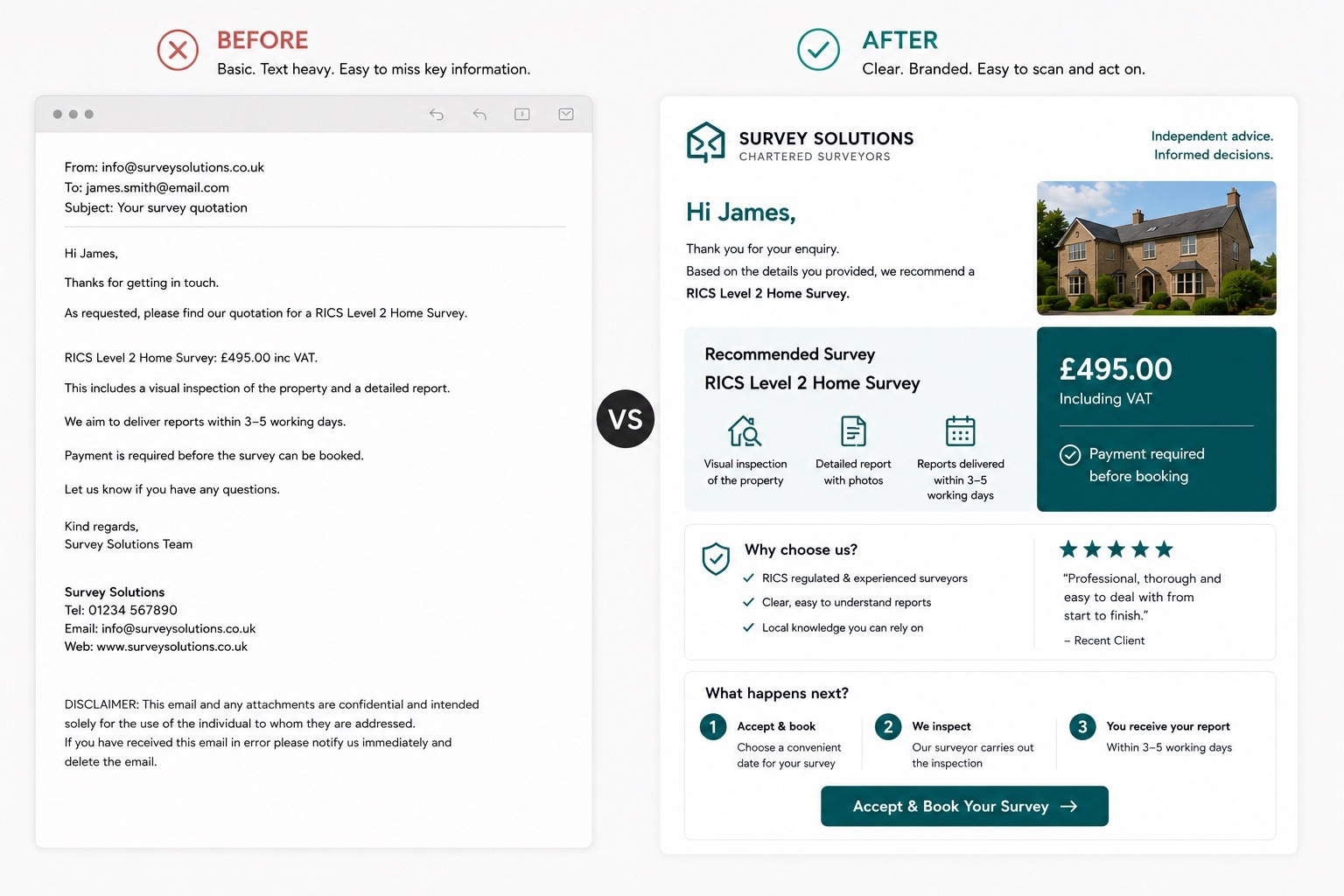
Good email design does not compete with the message. It makes the message easier to understand.
The anatomy of a strong quotation email
Take exactly the same surveying proposition:
RICS Level 2 Home Survey · £495 including VAT · Inspection available within five working days · Report typically delivered within three to five working days
A more structured communication can help organise that information around the customer’s decision.
Same firm.
Same survey.
Same price.
But one has deliberately considered how the customer receives and processes the information.
If you don’t communicate the value, customers are left comparing the price
This connects directly with another theme from The Modern Property Customer.
Customers do not necessarily select the cheapest surveying quotation.
Price matters, of course, but customers are also judging experience, qualifications, reviews, responsiveness, availability, professionalism and confidence.
The problem comes when a business fails to communicate those things.
If Firm A sends:
Level 3 Survey – £795
and Firm B sends:
Level 3 Survey – £895
but neither gives the customer much else to distinguish between them, the easiest difference to understand is £100.
The businesses have inadvertently turned a professional service into a price comparison.
Good communication makes your value visible before asking the customer to pay for it.
- Relevant surveying experience
- Local property knowledge
- Qualifications and professional credentials
- Report turnaround
- What is actually included
- Who will undertake the survey
- Independent customer reviews
- Availability
- Post-survey support
None of this requires aggressive sales language.
It simply means helping the customer understand the difference between price and value.
Presentation can help people understand information faster
There is a reason newspapers have headlines, websites have navigation and reports contain headings.
Humans do not approach every piece of information by carefully reading from the first word to the last.
We scan.
Visual hierarchy helps us determine what deserves our attention first.
The same principle applies to email.
White space, headings, typography, short sections and sensible visual structure can make that journey considerably easier.
More design does not automatically mean better design.
An email containing eight colours, enormous images, animations, six different buttons and half the company website is not necessarily more effective than a thoughtful text-based email.
Design should reduce cognitive effort.
Not increase it.
And please remember the phone
A beautifully presented desktop email that becomes unreadable on a mobile phone has missed the point.
Customers may open an enquiry response while travelling, sitting outside a viewing, at work or between appointments.
That makes responsive design particularly important.
- Use typography that remains readable on smaller screens
- Make buttons large enough to use comfortably by touch
- Avoid layouts that depend on wide desktop screens
- Test important customer emails before making them live
- Use sufficient colour contrast
- Use meaningful link text
- Add alternative text to useful images
There is also a broader accessibility point.
Clear sentences, sufficient contrast, sensible fonts, structured headings and useful alternative text make communications easier for more people to use.
If something is important, do not rely on an image alone to communicate it.
The email itself is only half of the equation
You could create the best quotation email in the surveying industry.
If it arrives three days too late, it may achieve absolutely nothing.
This is where messaging and operations begin to overlap.
A customer submits an enquiry at 7.30pm on Tuesday.
What happens next?
The quality of communication is not only determined by what is written in the template.
It is also determined by whether the right communication happens at the right time.
Speed matters - but speed doesn’t have to mean an immediate answer
Customers increasingly value responsiveness, but that does not mean a surveying practice needs somebody manually answering enquiries at every hour of the day.
Often, the first communication simply needs to reduce uncertainty.
Thanks for your enquiry. We’ve received the property details and a member of our team will review them. You can expect to hear from us by 10am tomorrow.
That email has not answered the enquiry.
But it has answered another important question:
“Has anyone got this?”
That matters.
Map the whole communication journey
Rather than treating each email as an isolated task, it can be useful to map the communication surrounding the entire customer journey.
Not every stage requires an email.
Not every email should be automated.
And certainly not every interaction should be templated.
But asking what the customer needs to know at each point can expose some interesting gaps.
- Has the enquiry been acknowledged?
- Does the quote clearly explain the recommendation?
- What happens if the customer does not respond?
- Does the customer know their booking has succeeded?
- Do they know what happens before the inspection?
- Do they know when to expect the report?
- Does report delivery explain what happens afterwards?
- Do they know whether post-report support is available?
A template should create consistency, not impersonality
The word template occasionally gets treated as though it means generic.
It does not have to.
Consider a surveying practice with several administrators and surveyors.
Without agreed templates, one customer might receive an excellent explanation of the service. Another gets three sentences. Another receives an outdated attachment. Another gets no explanation of what happens next.
Another receives something excellent because the person handling the enquiry happens to be particularly good at writing customer emails.
That is not personal service.
It is inconsistent service.
A good template establishes the minimum standard of communication. Personalisation can then sit on top of it.
Names, property details, survey type, surveyor, fee, appointment information and relevant customer circumstances can all make a structured communication feel specific to the individual.
Ideally, the recipient does not think:
“This is an automated email.”
They simply think:
“This company has made everything very clear.”
Automation should protect the human experience, not replace it
Some communications lend themselves extremely well to automation.
Others deserve a human being.
Good candidates for automation
- We have received your enquiry
- Your quotation is ready
- Your inspection has been booked
- Here is what happens next
- Your survey is taking place tomorrow
- Your report is ready
Where human expertise matters
- Significant defects have been identified
- A customer needs help understanding findings
- There are concerns about movement or damp
- The buyer is reconsidering the purchase
- Further investigation needs explaining
- Professional judgement is required
Automate the predictable so your people have more time for the valuable.
Good automation can still feel personal
Automation becomes impersonal when it ignores context.
Compare:
Dear Customer,
Your survey is booked.
with:
Hi Sarah,
Your Level 3 Building Survey for 24 Example Road is now booked for Tuesday
18 August. James, your surveyor, will carry out the inspection and we’ll let
you know once it has been completed.
Both messages could be automated.
Only one feels particularly relevant to the recipient.
The difference is not automation. The difference is the quality of the template and the information being used within it.
What about AI?
AI has made it extraordinarily easy to produce words.
That does not necessarily mean it has made it easy to produce good customer communication.
Used well, AI can be an extremely useful writing assistant.
But there is a considerable difference between asking AI for assistance and handing responsibility for your customer proposition to it.
AI does not automatically know your service standards, availability, terms, regulatory obligations, insurance position, report turnaround, tone of voice or what you genuinely provide.
So use it as an assistant.
Not as the final sign-off.
Check factual claims. Check promises. Check tone. Check links. Check formatting. And check that the communication still sounds like your business.
You don’t necessarily need to do it yourself
Not every surveying practice has a designer or marketing team sitting internally.
And there is nothing wrong with getting help.
Build it internally
For firms with somebody comfortable with copy, branding and email editors, creating templates internally can provide complete control.
Just make sure they are tested properly before being rolled out.
Use AI as a creative assistant
AI can dramatically reduce the time involved in brainstorming, restructuring and refining communications.
It works particularly well when you already know what you want to say but are struggling to say it clearly.
Ask your marketing or design agency
If you already work with an external agency, consider including email communication within the wider brand conversation.
A polished website and an inconsistent email journey can create a noticeable gap.
Use a specialist
Providers such as JAMY Business Support offer email branding and design support for customer communications.
Specialist help can be useful where internal design resource is limited.
There are also excellent free resources available from established email platforms, even if you do not use their software.
For example - Mailchimp provides practical guidance around email hierarchy, typography and responsive design.
What should surveying firms avoid?
Before rewriting your emails, map them
One of the most useful exercises may actually have nothing to do with design.
Open your current customer journey and list every email a client could receive.
Then ask four questions about each one:
Then ask a fifth:
Does this email need to exist at all?
You may discover three templates saying almost the same thing.
You may discover a major gap after instruction.
You may realise customers are repeatedly asking a question that could have been answered proactively.
Or you may find an email that was written five years ago and has simply survived because nobody has ever questioned it.
That exercise can be more valuable than immediately redesigning everything.
Look at what happens afterwards
Good email communication should not be based entirely on taste.
Where your systems allow it, look at what actually happens.
Be careful with email metrics themselves. Privacy protections and technical changes mean open rates are not always the clean measure they once appeared to be.
For a surveying practice, the more commercially meaningful outcome is often much simpler:
Did the customer progress?
The prettiest email is not necessarily the best email.
The best email is the one that helps the right customer understand the service, feel confident and take the appropriate next step.
Communication is part of your service
Property is moving towards greater digitalisation.
But digitisation should not mean making property feel less human.
Quite the opposite.
Good technology should remove unnecessary uncertainty and administration.
Good templates should ensure customers receive consistently useful information.
Good automation should make sure that information arrives when it is needed.
Good design should make it easier to understand.
And good people should still be there when expertise, judgement or reassurance is required.
That is why the question for surveying firms is not really:
“Should our emails be HTML or plain text?”
Nor is it:
“Should we automate our emails?”
The much more useful question is:
What does our customer need from us at this point in their journey - and what is the clearest, most effective way to deliver it?
Sometimes the answer will be a beautifully designed quotation.
Sometimes it will be an automated acknowledgement.
Sometimes it will be three lines of plain text.
And sometimes it will be picking up the telephone.
Good communication is not about choosing one format. It is about choosing the right communication for the right moment.
And when the message, presentation and timing all work together, email stops being something that simply leaves your outbox.
It becomes part of the reason a customer chooses you.
Sources & further reading
- Survey Booker – The Modern Property Customer: What Today’s Buyers Really Expect
- Survey Booker – Speed, Systems & First Impressions
- Mailchimp – Email Design Reference
- Mailchimp – Mobile Email Design Guidance
- UK Government – Inclusive Communication Guidance
- Information Commissioner’s Office – Electronic Mail Marketing Guidance
- JAMY Business Support – Email Branding & Business Support Services