
The Modern Property Customer:
What Today’s Buyers Really Expect
How speed, transparency, trust and changing buying behaviour are reshaping the way surveying firms win business.
Buying a property has never been an ordinary purchase.
For most people, it will be one of the largest financial commitments they ever make. There is uncertainty, emotion, significant expense and, frequently, a long list of professionals and organisations involved.
But while the fundamentals of buying a home may not have changed dramatically, the customer has.
People who can order almost anything online in minutes, track deliveries in real time, compare providers instantly and manage their banking from a phone are bringing those same expectations into property.
Although a surveying firm cannot control every part of a property transaction, it can control the experience customers have with it.
The property journey is creating friction
Research commissioned by the Open Property Data Association (OPDA), involving more than 5,300 people who had bought or sold a home within the previous five years, gives an interesting insight into where customers are experiencing frustration.
The message behind the figures is relatively simple. Customers are already navigating a complicated process. Every business involved has an opportunity to reduce rather than add to that complexity.
Property customers are doing more homework before they contact you
The traditional sales funnel has changed considerably.
A potential customer may once have phoned a local surveying practice following a recommendation from an estate agent, solicitor, friend or family member.
Today, they can have several browser tabs open simultaneously.
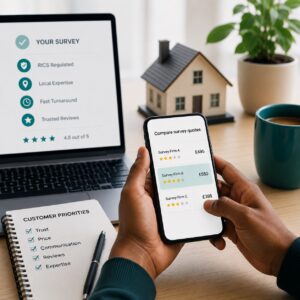
One contains your website. Another contains Google reviews. Another explains the difference between a Level 2 and Level 3 survey. Another contains a competitor’s quote. They may also be checking RICS credentials, asking for recommendations or using a comparison service.
Platforms such as reallymoving allow customers to receive multiple survey quotes and compare providers before choosing a surveying firm.
Your customer may be considerably further through their decision-making process than the simple word “lead” suggests.
They are not necessarily asking “Do I need a survey?”
They may instead be asking: “Why should I choose you to provide it?”
And the answer increasingly extends beyond price.
More choice makes the customer experience more important
This becomes particularly relevant when customers have greater choice.
Rightmove reported in July 2026 that the number of homes available for sale remained close to a 12-year high. Meanwhile, the RICS June 2026 Residential Market Survey recorded new buyer enquiries at a net balance of -29%, indicating that buyer demand remained subdued.
For surveying firms, it means making the most of every viable opportunity matters.
A prospective customer who has requested quotes from three firms does not necessarily have any reason to wait for Firm A simply because they contacted it first.
If Firm B provides a clear quote, demonstrates expertise, answers the customer’s questions and makes instruction easy while Firm A’s enquiry remains sitting unnoticed in an inbox, the purchasing decision may already have been made.
Responsiveness has effectively become part of the product.
The transaction already contains enough uncertainty
One of the clearest findings from recent research is just how far the current buying process can sit from customer expectations.
OPDA found that buyers typically expected exchange of contracts considerably sooner than it actually happened. Only 6.7% reported exchange taking place within a month, while 29.5% completed exchange within one to two months, 45.9% took between three and six months, and around 16% waited longer than six months.
The UK Government now describes the average purchase as taking around 120 days once an offer has been accepted, with approximately one in three transactions falling through.
Whatever measure is used, the conclusion is much the same: customers are entering a long, stressful and uncertain process.
The individual businesses involved therefore have an opportunity to reduce rather than add to that uncertainty.
Communication has become part of the sale
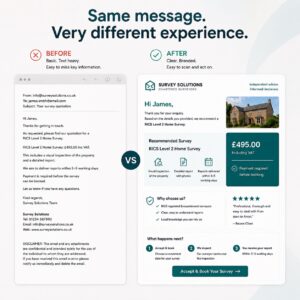
Customers do not simply judge the final report.
They judge everything around it.
None of those things alters the technical competence of the inspection.
But collectively, they can dramatically alter the customer’s perception of the service.
Silence creates work for customers.
Every time somebody has to ask “Have you received this?”, “What’s happening?”, “When is the survey?” or “When should I expect the report?”, the customer is effectively managing part of the process themselves.
Good communication removes that burden.
And importantly, communication is not only a customer-service issue once the instruction has been won.
It can influence whether the instruction is won in the first place.
Customers want digital convenience - but not necessarily a faceless service
There is sometimes a tendency to frame technology and personal service as opposites.
The evidence suggests that is the wrong way to look at it.
Property customers appear increasingly to want digital convenience around human expertise.
OPDA’s research found considerable enthusiasm for better digital infrastructure: 82.2% viewed the idea of a digital property pack positively, while 76.7% said they would be willing to use technology enabling secure sharing of property data and information.
The Government’s current homebuying reforms are moving in a similar direction, with digital property information, electronic signatures, digital identity and improved visibility of transaction progress all part of proposals to modernise the process.
That should not be interpreted as customers wanting everything automated.
It means they increasingly expect the administrative parts of a service to be easy.
A customer should not need a telephone conversation simply to find out that their inspection has been booked.
Equally, when their Level 3 report identifies something potentially serious, they may value speaking to an experienced surveyor enormously.
Technology is best used to remove unnecessary administration so that human expertise is available where it provides genuine value.
Repeating yourself feels increasingly outdated
Another revealing figure from the OPDA study concerns information.
62.3% of respondents said they had been asked to provide the same information or documents two or three times during their property transaction.
Anyone working in property will understand why. Different organisations have different regulatory obligations, systems and processes.
To the customer, however, it simply feels repetitive.
If somebody has already entered their name, property address, telephone number and email address into an enquiry form, asking them to provide everything again unnecessarily during booking creates friction.
Capture information once. Use it intelligently thereafter.
Transparency is becoming a sales tool
Government research acknowledges that consumers can have limited support when choosing property professionals and may find it difficult to assess whether a particular provider offers the right service.
Current reform proposals therefore look towards greater transparency around areas such as professional specialisms, quality and speed of service and the use of digital processes.
That tells us something about the direction customer expectations are moving.
Businesses increasingly need to demonstrate why they are good, rather than simply state that they are.
- Local expertise and knowledge of the property stock
- Specialist property experience
- Qualifications and professional regulation
- Typical inspection and report turnaround times
- What happens after instruction
- Whether post-report discussions are available
- Customer testimonials and independent reviews
- Exactly what the quoted fee includes
This does not need to turn a professional practice into an aggressive sales operation.
Clarity sells.
Why do some surveying firms convert more opportunities than others?
Attracting an enquiry is only the beginning.
There is a point where marketing performance, sales performance and operational performance begin to overlap.
A firm could generate 100 good enquiries, but if responses are slow, quotations are not followed up, customers receive inconsistent information or the journey to instruction is unnecessarily complicated, some of those opportunities will inevitably be lost.
This is something we touched upon when looking at an independently published Konnect You Top 10 list of surveying practices.
The ranking itself was independently determined by Konnect You and considered factors including verified customer reviews, average ratings, professional regulation, insurance and service standards.
That does not mean software creates a successful surveying practice. Far from it. The professional expertise, reputation and service delivered by the people within those businesses remain fundamental.
“Great surveying will always come down to the expertise, judgement and service provided by the people within a practice. Technology cannot replace any of those things, but it can create the operational environment that allows them to be delivered more consistently.”
High-performing surveying firms still face exactly the same everyday challenges as everyone else. Enquiries need acknowledging. Quotations need preparing. Leads need following up. Terms need issuing. Appointments need arranging. Customers need updating. Reports need delivering. Reviews and referrals need nurturing.
Strong systems and processes do not create the expertise behind a successful surveying business.
They help make sure that expertise is not undermined by the experience surrounding it.
Read the Konnect You Top 10 articlePrice matters - but cheapest doesn’t always win
There is an understandable temptation in a competitive market to assume that winning more instructions means being cheaper.
If another surveying firm quotes £50 less, should you reduce your fee? If another reduces theirs again, should you follow?
Taken far enough, that quickly becomes a race to the bottom.
And what we see across surveying businesses is that customers do not necessarily choose the cheapest quote.
Price undoubtedly matters. But it is only one part of the decision.

Customers are also weighing up experience, qualifications, reviews, availability, responsiveness, perceived professionalism, what is included within the service and, perhaps most importantly, how much confidence they have in the person or business they are about to instruct.
There is some interesting psychology behind this
Consumer-behaviour research has repeatedly demonstrated what is known as the price-quality inference: when customers cannot easily assess quality before purchasing, they may use price as one of the clues from which they infer it.
Research published in the Journal of Consumer Psychology found that consumers can rely heavily on price when predicting quality. Research published in the Journal of Retailing has similarly observed that consumers do not always purchase the lowest-priced option, even where alternatives appear otherwise similar.
Price can therefore perform two competing roles: it represents a greater financial cost, but can also act as information from which a customer infers quality.
That is particularly relevant to professional services.
Before instructing a surveyor, most homebuyers cannot objectively assess the quality of the inspection they are going to receive. They have not seen the property inspected. They have not read the report. They have not experienced the surveyor’s judgement or advice.
They are therefore making a decision under uncertainty.
Price becomes one signal amongst many. Reviews are another. Professional credentials are another.
The quality of the website, the clarity of the quotation, how quickly somebody responds, how well the service is explained and how professional the company appears all contribute towards the same judgement:
“Do I trust these people with something this important?”
When being too cheap can work against you
This is where aggressive discounting can become counterproductive.
A significantly cheaper quotation may initially attract attention, but it can also create another question:
“Why are they so much cheaper?”
That does not mean charging more automatically makes a business appear better. An unjustifiably high fee can obviously lose an instruction just as easily.
The important concept is perceived value.
Customers are rarely assessing price in isolation. They are comparing what they are being asked to pay with what they believe they are receiving in return.
And in surveying, that distinction matters enormously.
A Level 3 survey is not simply a PDF.
Behind it sits professional training, experience, inspection time, specialist knowledge, professional indemnity insurance, regulation, report preparation, judgement, liability and potentially post-survey advice.
If none of that value is communicated effectively, the customer is left with one particularly easy thing to compare:
The price.
Don’t make price do all the talking
Imagine a customer receives three quotations:
There is absolutely no guarantee that Firm C wins.
For some customers, it will.
For others, Firm B may represent substantially better value, despite costing more.
The objective should not necessarily be: “How do we become the cheapest?”
A much healthier question is: “How do we make the value of choosing us clear?”
That might mean communicating specialist expertise, local knowledge, turnaround times, professional credentials, customer reviews, service standards, report quality, post-survey support or simply providing a noticeably better experience from the first enquiry.
The danger of the race to the bottom
Continually reducing fees has another commercial consequence too.
Lower margins can mean needing to complete more surveys to generate the same revenue. More volume can place greater pressure on surveyors and administrative teams. That can reduce the time available for communication and customer care - precisely the areas today’s customers increasingly value.
The alternative is not simply to charge more.
It is to compete on value rather than price alone.
Good value and cheapest are not the same thing.
The surveyor occupies a particularly important moment in the buying journey
Surveying differs from many other professional services because of when the customer encounters it.
The buyer has normally already found a property, made an offer, started arranging finance, appointed a solicitor and begun emotionally imagining themselves owning the home.
Then the surveyor arrives.
The survey can be the moment at which optimism encounters reality.
Damp. Movement. Roof defects. Services. Alterations. Further investigations. Unexpected repairs.
A good survey therefore does more than identify defects.
It helps somebody make sense of risk.
That makes trust an extraordinarily valuable part of the surveying sales proposition.
Customers are not simply buying a document. They are buying independent expertise at one of the moments when they are most likely to question whether they are making the right decision.
What does all of this mean for surveying firms?
It does not mean every practice needs somebody sitting beside the phone 24 hours a day.
Nor does it mean automating every customer interaction.
It means looking at the sales journey through the customer’s eyes.
From generating leads to understanding what converts them
There is another important part of modern sales performance that is sometimes overlooked.
It is not enough simply to generate enquiries.
Businesses need to understand what happens to them afterwards.
Without that visibility, it is very easy to make sales decisions based on instinct.
A comparison platform, for example, might generate a large number of enquiries and appear highly successful at the top of the funnel. But if relatively few convert, another source producing fewer but better-qualified opportunities may ultimately be more valuable.
The number of leads tells you how much opportunity entered the business. Conversion data tells you what happened to it.
And once a business understands that journey, it can start improving it.
But data alone doesn’t win the instruction
Understanding conversion is only half of the equation.
You can generate leads through comparison websites. You can invest in SEO. You can build strong referral relationships. You can advertise. You can improve your website. You can measure conversion rates.
All of those things matter.
But once an opportunity reaches your business, the experience you create around it becomes yours to control.
The customer does not experience your marketing strategy or your internal systems.
They experience:
- The email they receive
- The speed of your response
- The way the quotation is presented
- The explanation of your service
- The ease of accepting it
- The confidence created by your reviews, credentials and expertise
- The follow-up if they do not respond
- The communication once they instruct
- The updates they receive
- The support they receive after the survey
That continuity matters.
Because a brilliant first response followed by silence is not a brilliant customer journey.
Neither is a beautifully presented quotation followed by poor communication.
And sophisticated automation achieves very little if the messages being automated are impersonal, unclear or badly timed.
Technology can create consistency. But the quality of what you consistently deliver still matters.
The small things become the big things
Perhaps that is the biggest lesson from the modern property customer.
Winning more business is not necessarily about generating more leads.
It is not necessarily about being the cheapest.
And it certainly is not about automating every interaction.
Often, it is about doing the relatively ordinary things extraordinarily well - and doing them consistently.
For surveying firms, professional expertise will always sit at the heart of the service.
But in a world where customers can compare providers more easily than ever before, expertise alone is not always visible at the point they make their decision.
The experience surrounding that expertise is what helps customers recognise its value.
And perhaps that is the real shift in modern property sales.
The firms that stand out will not necessarily be those shouting the loudest or charging the least.
They will be the ones that make customers feel confident they have made the right choice - before, during and after they make it.
Sources & further reading
- Open Property Data Association, The Future of Homebuying .
- UK Government, Homebuying shake-up to slash delays, cut costs and stop sales falling through , June 2026.
- UK Government, Home Buying and Selling Reform .
- RICS, UK Residential Survey – June 2026 .
- Rightmove, House Price Index – July 2026 .
- reallymoving, Compare surveyor quotes .
- Cronley, Posavac, Meyer, Kardes & Kellaris, A Selective Hypothesis Testing Perspective on Price-Quality Inference , Journal of Consumer Psychology.
- Ding, Ross, Rao & Rao, Price as an Indicator of Quality , Journal of Retailing.
- Survey Booker, Survey Booker Powers Over 50% of the Firms Featured in a Konnect You Top 10 .