Guest Insight · Projekt3
Compliance Is Not Quality (And Quality Is Not Compliance)
We are delighted to welcome this guest article from Kate Charrington of Projekt3, who explores an important distinction that is often overlooked within residential surveying: the difference between compliance and genuine quality.
We are delighted to welcome this guest article from Kate Charrington of Projekt3, who explores an important distinction that is often overlooked within residential surveying: the difference between compliance and genuine quality.
Meeting professional standards is essential, but as Kate explains, compliance provides the baseline rather than the measure of an exceptional service. From post-report discussions and the use of modern inspection tools to internal review, peer challenge and independent assessment, this thought-provoking piece asks surveyors to look beyond claims of “high quality” and consider the evidence that supports them.
It is a timely and valuable contribution for any residential surveying practice seeking to strengthen assurance, improve consistency and demonstrate a genuine commitment to continuous improvement.
Ask a group of residential surveyors what makes their service stand out, and you will hear some familiar responses.
All good things. All potentially valuable.
But let me ask you this question:
The distinction matters more than many residential surveyors realise. In recent years, compliance and quality have had increased emphasis and quite right too. The current version of the RICS Home Survey Standard (2019) aimed to support in greater consistency in service delivery and to meet evolving customer expectations. That’s great, but somewhere along the way, compliance and quality have become blurred together.
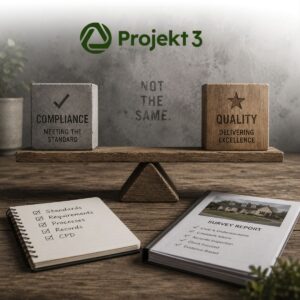
Yes, they’re related. Yes, they’re important. But they’re not the same thing.
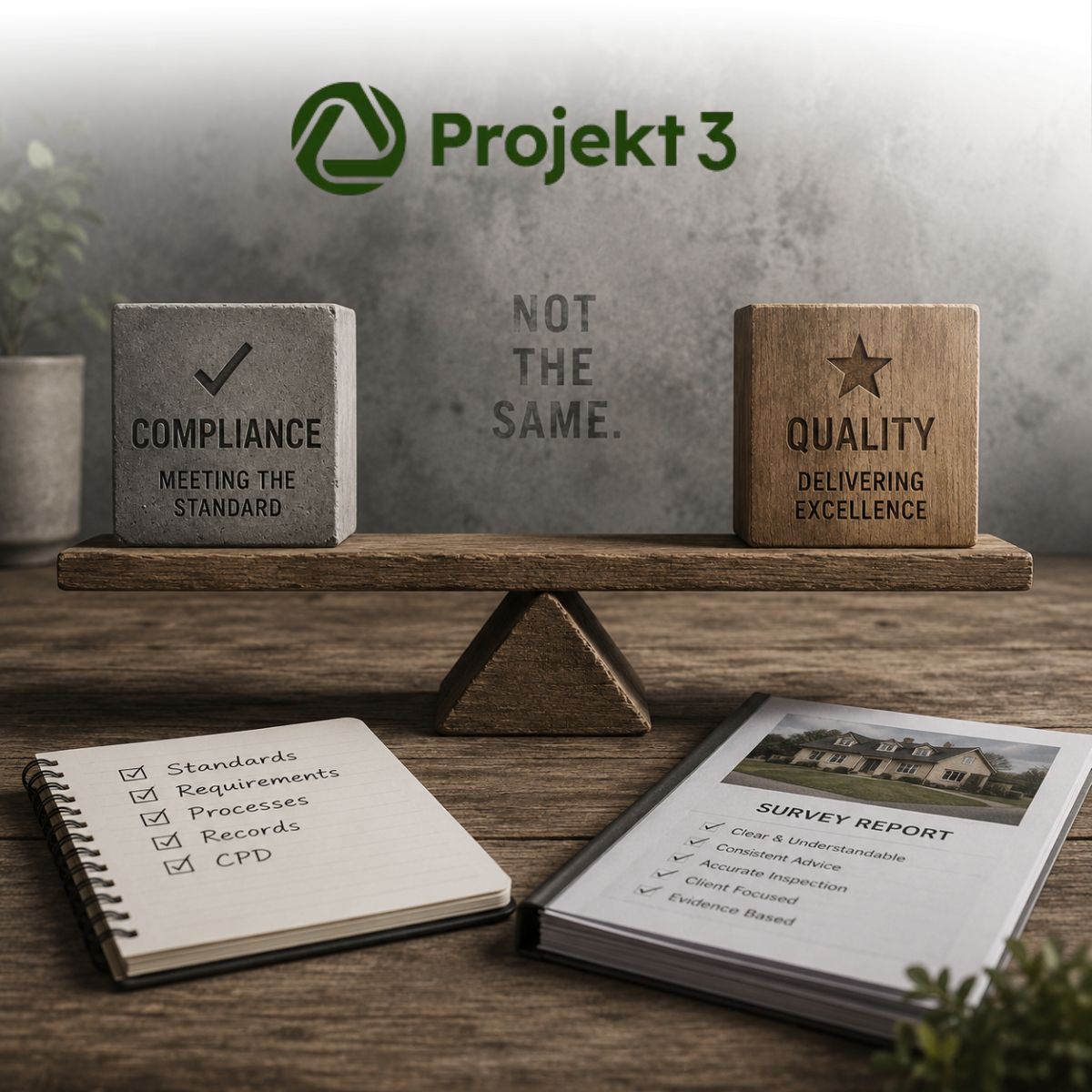
Compliance: Meeting the Standard
Compliance is straightforward in terms of a concept. In home survey terms, it means meeting the minimum requirements that govern how we practise. This could include; following professional standards (e.g. RICS Home Survey Standard); delivering the required service (i.e. Level 1, 2 or 3); maintaining records in accordance with RICS standards and legal requirements, keeping up with CPD to ensure you are competent to carry out the work you do and operating within a recognised framework.
As an example, the RICS Home Survey Standard (2019) requires surveyors to make themselves available to discuss the contents of a report after it has been issued. Yet, many surveyors still cite post-report conversations as a key differentiator.
The reality is that it isn’t a differentiator at all. Rather, it’s what consumers should reasonably expect from every compliant surveyor.
Similarly, the use of drones was once considered innovative. If I think about the evolution of surveying technology during my time in the profession, early adopters for sure gained a competitive advantage through improved inspection capability. Today, however, drones are increasingly commonplace across the profession. In other words, simply owning and using drones during an inspection can no longer distinguish a service. Many surveyors now use it BAU for inspections, others as an ‘additional service’. Either way, it is not something that differentiates any more.
Compliance and modern tools can create a baseline (equipment evolves and what is not standard equipment now may be standard equipment tomorrow). Use of this type of equipment however does not automatically demonstrate quality.
Quality: The Harder Question
Quality is far more difficult to define and even harder to prove.
Most surveyors describe on their website or marketing materials that they produce ‘high quality’ home survey reports. Understandably so nobody markets themselves as average!
But, if every surveyor claims to provide ‘high quality’, how do consumers, or indeed surveyors themselves, know whether that quality genuinely exists?
Quality isn’t something we can just declare it’s something we must evidence.
A genuinely high-quality report might for example demonstrate:
Clear and understandable language.
Consistent application of condition ratings/risk communication.
Appropriate inspection detail.
Client-focused content.
Accurate application of professional standards.
The challenge though, is that many of these things are subjective when viewed in isolation. And, when you’re close to your own work, it’s remarkably difficult to assess it objectively.
Which raises another important question:
How do we actually know whether our reports are achieving the standard we believe they are?
Looking in the Mirror
For many firms, the first answer is internal review. This can be through proof-reading, quality checks and file audits all of which are super valuable tools. They help identify errors, inconsistencies and opportunities for improvement.
For sole practitioners, self-review will often become the default mechanism. Every surveyor should review their work before it reaches a client.
But self-assessment has limitation, including ‘blind spot bias’ i.e. we can find critique/weakness in others more easily than in ourselves.
The same principle applies to home survey reporting. When you’ve spent hours inspecting a property and writing a report, you already know what you intended to say. Your brain fills in gaps, overlooks ambiguities and assumes clarity where a client may see confusion.
Internal reviews are an imperative first line of compliance and quality assurance. But, when the reviewer is also the author, total objectivity becomes a little difficult.

The Importance of Peer Review
This is where peer review becomes particularly valuable as a second part of quality and compliance processes. A fresh pair of professional eyes can identify issues that the original surveyor may never spot. That might be inconsistent advice, unclear wording or even occupancy risks that have been missed. Another professional may find recommendations to be too ‘back covering’ with insufficient justification for further investigations.
Peer review introduces challenge and professional scrutiny. It encourages consistency throughout firms and creates opportunities for shared learning.
Many surveyors will recognise some of their most valuable professional development moments as those occasions when another surveyor questioned an assumption or interpreted something differently. That’s healthy and how professional standards evolve.
But peer review within firms also has limitations. Colleagues often work within the same culture, processes and reporting approaches. Over time, entire teams can become accustomed to certain reporting habits (or ‘the firm approach’) without ever questioning whether they’re genuinely effective.
Peer review remains essential, yet it may not always provide complete independence.
The Value of Independent Perspective
This brings us to a third layer of assurance: independent external review. Not because external reviewers possess some special insight unavailable to practising surveyors. Rather because independence removes a lot of bias that naturally exists within internal systems.
An external reviewer has:
No involvement in the inspection.
No ownership of the report.
No attachment to the outcome.
Little to no knowledge of a firm’s way of going about things (initially at least).
That independence can provide a different perspective on both compliance and quality. Importantly, compliance and quality should be assessed separately.
A report, for example, can be fully compliant and still leave considerable room for improvement. Equally, a technically impressive report may contain compliance weaknesses that create professional and consumer risk.
Both dimensions matter.
A Useful Question for Every Surveyor
Perhaps the most important question isn’t:
‘Are my reports compliant?’
Nor is it:
‘Are my reports high quality?’
The more valuable question to ask yourself may be:
Evidence changes the conversation. It moves quality beyond personal opinion. It transforms compliance from assumption into assurance. Additionally, it provides a foundation for continuous improvement.
As professional standards evolve, consumers are becoming more informed and expectations are also increasing. In this environment, simply claiming ‘high quality’ may no longer be enough.
The residential surveyors who stand out in the years ahead are unlikely to be those who rely solely on marketing statements or equipment.
They’ll be the surveyors who can clearly demonstrate how they monitor, measure and improve the quality of the service they provide.
Compliance sets the floor. Quality defines the ceiling.
The most successful firms understand the difference and can evidence both.
About Projekt3
This article’s central message, that quality must be evidenced rather than simply claimed, sits at the heart of Projekt3’s work.
Founded and led by Kate Charrington FRICS, Projekt3 provides independent, expert-led support to residential surveyors and surveying practices seeking to improve the quality, clarity, consistency and compliance of their home survey reports. Through confidential report reviews, training, mentoring and practical guidance, Projekt3 helps firms identify blind spots, strengthen their reporting processes and build greater confidence in the service they provide.
Its independent perspective is particularly valuable. When you work closely with your own reports every day, it can be difficult to see where wording may be unclear, advice inconsistent or established ways of working could be improved. Projekt3 provides constructive, objective scrutiny designed not simply to identify shortcomings, but to support meaningful and continuous professional development.
For surveyors who are serious about demonstrating quality rather than merely declaring it, we would warmly recommend speaking with Kate and exploring the support Projekt3 can provide.
Visit the Projekt3 website to learn more or get in touch directly.
You can also explore its services, including an exclusive offer available to Survey Booker customers, through the Projekt3 page in the Survey Booker Services and Suppliers Directory.
Discover More
Connect with Kate Charrington, visit Projekt3, or explore further information and the exclusive Survey Booker customer offer.