
Residential surveyors who run their own practices are rarely responsible for surveying alone.
Before an inspection begins, they may already have responded to enquiries, prepared quotations, arranged appointments, issued terms of engagement, chased information and answered client questions. After returning from site, there are reports to write-but also payments to monitor, diaries to manage, leads to follow up, records to maintain and a business to run.
That breadth of responsibility is often treated as an unavoidable part of being an independent professional. To a degree, it is. Small-business owners have always needed to be adaptable.
This is not simply a conversation about efficiency or achieving a better work-life balance. It is also a question of professional capacity.
Surveyors need time to inspect carefully, analyse evidence, exercise judgement, communicate clearly and remain close to the standards that govern their work. When professional attention is repeatedly divided between technical practice and every operational demand of the business, something eventually has to compete for space.
A Timely Question for Residential Surveying
The proposed second edition of the RICS Home Survey Standard has generated considerable debate throughout the profession. That debate is healthy. Professional standards should be examined critically by the people expected to apply them, and RICS has actively sought feedback from members, consumers and other stakeholders.
The current first edition remains the applicable standard. Introduced in March 2021, it established mandatory requirements for RICS members and regulated firms delivering residential property surveys in the UK, with the aim of setting minimum expectations and supporting consistent, high-quality services.
Following consultation on a proposed second edition, RICS confirmed in April 2026 that it was continuing to work through the responses received and would share an updated publication timeline as the draft develops.
Much of the public discussion has understandably concentrated on what may change. Yet some commentary has described principles as entirely new when equivalent or related expectations can already be found within the current framework.
How much protected time do busy practitioners genuinely have to revisit the standards already governing their work, distinguish clarification from substantive change and consider how requirements translate into everyday practice?
That observation should not be used to question the competence of individual surveyors. The standard is detailed, professional practice is complex and the proposed revision has prompted legitimate technical questions. It does, however, raise a wider issue about the time and attention available for professional reflection.
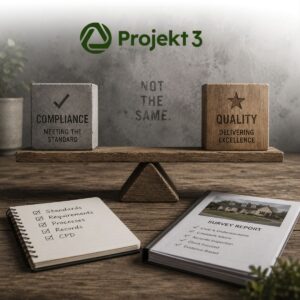
Knowing a Standard Exists Is Not the Same as Embedding It
Professional competence is not maintained simply by obtaining a qualification or reading a standard once. Standards need to be revisited. Established practices need to be challenged. Templates, terms, inspection routines and client communications need to be reviewed as expectations evolve.
The RICS Rules of Conduct require members and firms to maintain professional competence, ensure services are provided by people with the necessary expertise, and provide good-quality and diligent services.
Formal continuing professional development is an important part of this. However, remaining current involves more than reaching an annual total of CPD hours. It includes:
- reading and interpreting updated standards and supporting material
- reflecting on whether existing procedures remain appropriate
- reviewing report content, terminology and limitations
- discussing difficult cases with professional peers
- learning from queries, complaints and quality reviews
- implementing changes across the wider business
All of this requires time and attention. Both are finite.
The Many Roles Hidden Inside a Small Practice
Independent surveyors often have an extraordinary range of responsibilities. The same individual may act as surveyor, report writer, business owner, administrator, salesperson, credit controller, marketing manager, compliance lead, technology manager, diary coordinator and customer service team.
This versatility deserves recognition. It is one reason smaller practices can offer such personal and responsive services. But versatility can become dilution.
The risk may appear subtly: CPD becomes something to complete rather than absorb; guidance is saved for later but never revisited; templates remain unchanged; file reviews are postponed; and proposals are assessed from headlines rather than against the current standard itself.
Administrative Pressure Can Become a Professional-Practice Risk
The administrative work surrounding an instruction is not unimportant. Enquiries must be acknowledged. Terms must be issued. Appointments must be confirmed. Payments and documents must be managed. Clients need timely communication and the firm needs accurate records.
But most of these activities do not require the personal intervention of a qualified surveyor every time they occur. When they consume a disproportionate amount of the surveyor’s working day, they take time from the work that cannot simply be delegated or automated:
- interpreting evidence and making technical judgements
- considering the significance of defects and assessing risk
- tailoring advice to the client and property
- reviewing professional standards and improving report quality
- reflecting on difficult or unusual cases
A practice may appear busy and productive while the surveyor at its centre has less and less time available for surveying in its fullest professional sense.
What Genuinely Requires a Surveyor?
One useful exercise is to separate the practice’s activities into three broad groups.
Professional judgement
Inspection, analysis, risk assessment, interpretation, technical advice and decisions requiring surveying knowledge and accountability.
Skilled human involvement
Client care, complex enquiries, complaints and relationship management, with escalation where professional input is required.
Routine, repeatable processes
Acknowledgements, reminders, document requests, quotation follow-ups, payment chases, internal tasks and standard progress updates.
The aim is not to remove people from the service. It is to ensure qualified professionals are not routinely carrying out work that could be completed just as effectively-and often more consistently-through another person, a defined process or a well-designed system.
People, Process and Technology
There is no single correct operating model. A sole practitioner may not be ready to employ an administrator. A growing firm may need clearer responsibilities across its team. A larger practice may require dedicated operational, compliance and technical leadership.
The right people
Professional administrators and operations staff bring expertise of their own. They can manage communication, coordination and routine processes while understanding when a matter requires escalation.
Clear processes
Adding staff without defining how work should be managed can simply spread inconsistency across more people. Strong practices establish clear ownership, communication, record-keeping and escalation procedures at each stage of an instruction.
Appropriate technology
Technology can ensure routine steps happen consistently, provide visibility across the practice and reduce dependence on individual memory.
Technology Cannot Read the Standard for You
No CRM, workflow or artificial intelligence system can make a professional competent. Technology cannot determine the significance of an observed defect or take responsibility for advice given to a client. Nor should it.
What it can do is create more space for the person who can.
A well-designed system can:
- centralise enquiry and instruction information
- issue routine communications consistently
- track terms, documents and payments
- create actions and reminders automatically
- give administrators and surveyors shared visibility
- preserve communication and decision histories
- reduce repeated data entry
- provide an accessible audit trail
- make it easier to identify where attention is required
The value is not merely that an email takes less time to send. It is that the surveyor is interrupted less often by tasks that do not require professional judgement.
Supporting the Work Around the Survey
This principle sits at the centre of Survey Booker. The platform was not created to carry out inspections, form professional opinions or write advice on behalf of surveyors. It was built to support the considerable amount of work surrounding each instruction.
Enquiries, quotations, terms, communications, appointments, payments, documents, tasks and job progression can be managed within one connected surveying business platform. Workflows can support routine processes. Administrative teams can see what requires action without relying on the surveyor to brief them continually, while records remain connected to the instruction.
Sole practitioners
Additional operational capacity without immediately adding headcount.
Supported practices
Structure and visibility that help administrators work more independently.
Growing firms
Less dependence on every operational question flowing through one surveyor or director.
The purpose is not to make a practice less personal. It is to protect the time required for meaningful personal and professional input.
The Difference Between Being Busy and Being Well Supported
A full diary may demonstrate demand. A constantly interrupted surveyor may demonstrate something else.
If the owner remains the only person who knows which enquiry needs chasing, whether terms were accepted, which client is awaiting an answer, whether payment has been received, what document is missing and what should happen next, the firm may have a dependency problem rather than simply a workload problem.
A Question of Professional Attention
The discussion surrounding the next Home Survey Standard provides an opportunity to examine the environment in which professional standards are being applied.
Questions for every practice
- Do surveyors have enough time to read current and proposed material properly?
- Can they compare new wording with existing obligations?
- Do they have space for meaningful technical discussion rather than reactive commentary?
- Are internal templates and procedures reviewed systematically?
- Can the team step back from daily operations long enough to test whether the practice is still working as well as it believes?
If the answer is no, the solution is not simply to work harder or manage time better. The structure around the surveyor needs attention.
Protecting Time for Professional Practice
Practice owners need commercial awareness, leadership and oversight. But oversight does not require personal involvement in every routine action.
A more resilient model begins by asking:
- Which activities genuinely require a qualified surveyor?
- Which could be owned by a capable administrator?
- Which could be standardised through a defined process?
- Which could happen automatically?
- Where does information depend on one person’s memory?
- What repeatedly interrupts technical work?
- What professional activity is postponed because administration feels more urgent?
Surveyors Should Not Have to Become the Entire Business
The strongest surveying firms will not necessarily be those whose surveyors do everything themselves. They will be those that understand where professional expertise adds irreplaceable value and build the right support around it.
That support may come from an experienced administrator, a better-defined team, clearer processes, specialist technology or-most likely-a combination of all four.
The more effectively the operational work is supported, the more time remains for the work clients ultimately instructed them to do:
Support the work around the survey
Survey Booker brings enquiries, quotations, communications, appointments, payments, documents, tasks and workflows together in one business management platform designed specifically for surveying firms.
Book a discovery call Request a personalised demonstration