
Survey Booker Editorial · Workflows
The Firms That Stand Out Don’t Leave Good Processes to Chance
Why workflows are one of the most powerful, yet underused, tools available to surveying practices.
Every surveying practice has processes. The difference between firms is not whether these activities happen. It is how reliably they happen.
An enquiry arrives. A quotation is prepared. A client needs following up. Terms are issued. Payment is requested. An appointment is arranged. Documents are collected. Tasks are assigned. Updates are sent.
For many smaller and independent surveying practices, much of this activity still relies on personal memory, diary notes, manually created tasks and repeated emails. That approach may work when instruction volumes are manageable and the same person remains close to every job.
The difficulty comes when the phone is ringing, inspections are filling the diary and clients all need an answer at once.
It is at that point that seemingly minor inconsistencies begin to matter. A quotation is not followed up. An enquiry receives no further contact. A referral relationship quietly becomes inactive.
None of these failures is usually caused by a lack of care. They happen because the process depends on someone remembering what to do next.
This is where workflows can make a significant difference.
The principle
More Than an Automation Feature
Workflow automation is sometimes dismissed as something too technical, too impersonal or only necessary for larger businesses.
In reality, it can be one of the most valuable tools available to a small practice.
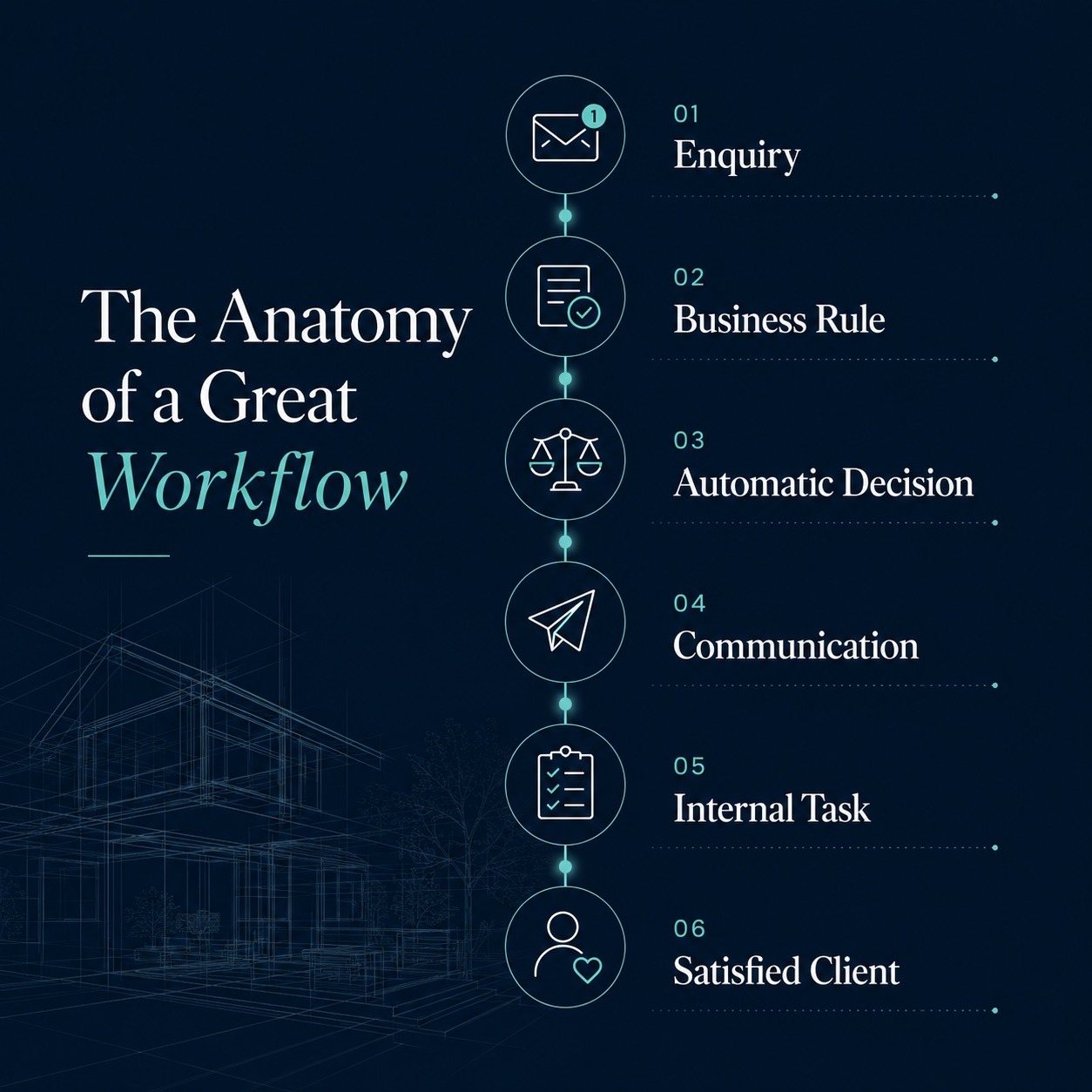
A workflow simply takes a process the business already understands and ensures the next appropriate step happens consistently.
Trigger
Something happens within the business or client journey.
Condition
Survey Booker checks whether the relevant rule applies.
Action
The system completes the next appropriate action automatically.
FConsider a survey instruction reaching a particular stage. Rather than relying on a manual reminder, the next communication or internal task can happen automatically, ensuring every client receives the same consistent experience while reducing administrative effort.
Or a potential client has not responded after three contact attempts. The relevant contacted status is selected. Survey Booker sends a polite email asking whether assistance is still required.
The technology may be sophisticated, but the principle is straightforward. It is about ensuring that the processes a practice already knows are important do not disappear when people become busy.
The operational burden
The Hidden Cost of Manual Processes
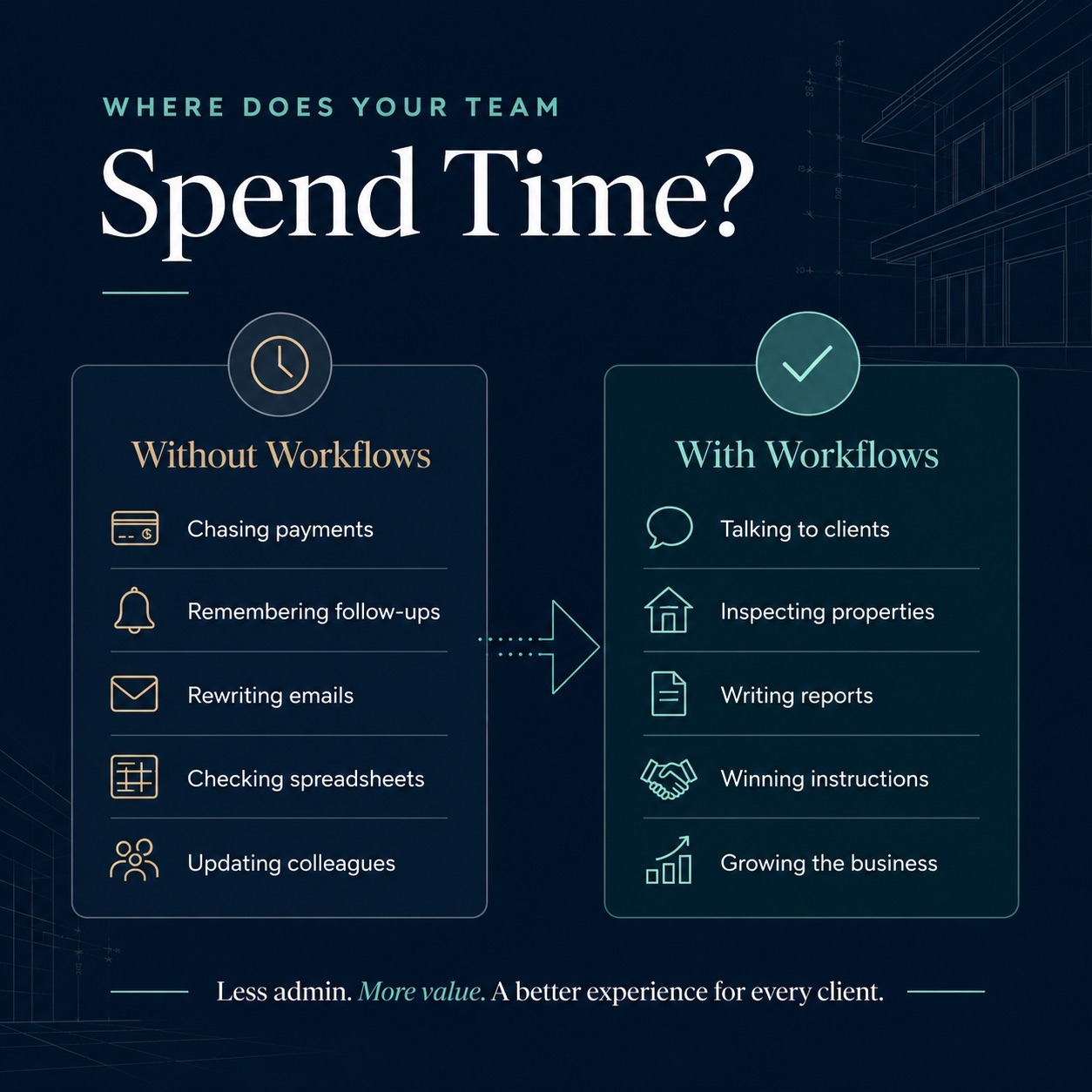
The time consumed by repetitive administration is not always obvious because it is spread across the working day.
A few minutes writing a familiar email. Time spent reviewing old enquiries. A reminder added manually. A referral partner list checked when somebody remembers.
Individually, these activities may appear insignificant. Repeated across every enquiry, instruction and member of staff, they can represent a considerable operational burden.
There is also a less visible cost. When processes are completed manually, their outcome may vary according to:
- who is working that day
- how busy they are
- whether they remember
- what wording they choose
- whether they have access to the right information
- whether the task appears urgent enough at that moment

People first
Automation Does Not Have to Feel Impersonal
One of the most common concerns surrounding automation is that it will make the client experience feel generic.
That only happens when the wrong things are automated, or when the wrong message is sent at the wrong time.
Good automation should support relationships rather than weaken them.
- An enquiry acknowledged promptly feels attentive.
- A relevant follow-up feels helpful.
- A reminder sent at the appropriate stage provides clarity.
- An internal task assigned automatically ensures somebody takes ownership.
In each case, the workflow is not replacing personal service. It is creating the structure that helps the practice deliver that service consistently.
Automate repetition, not relationships.Survey Booker Workflows
Surveyors should remain responsible for the conversations, reassurance, advice and professional judgement that clients value most. Workflows simply reduce the administrative noise surrounding those activities.

Built for surveying
Not All CRM Automation Begins in the Same Place
Workflow automation is not unique to Survey Booker. Major CRM platforms provide powerful tools capable of automating communications, sales activities, task allocation and wider business processes.
For organisations with the resources and expertise to design and configure them, broad CRM platforms can offer considerable flexibility.
The distinction lies in the starting point.
A general CRM is designed to serve many types of business. Before meaningful surveying automation can begin, the firm may first need to define how its enquiries, quotations, clients, properties, instructions, appointments, payments, services and job stages should fit within the system.
Survey Booker starts with the surveying context already in place.
Its workflows operate within a platform designed around the lifecycle of a survey, valuation or related professional instruction, from initial enquiry and quotation through to appointment, job progression, communication, documentation and completion.
That allows practices to move more quickly from:
to
“Survey Booker now handles that step consistently for us.”
This does not mean broad CRM platforms are inherently unsuitable. It means that the presence of a workflow builder is not the only question a surveying firm should ask when comparing systems.
Beyond the database
The Difference Between Recording Work and Supporting It
Many businesses use CRM software primarily as a database. Contacts are stored. Quotations are recorded. Jobs appear in a pipeline.
But the people within the business still remember every chase, send every repeated email, create every task and decide manually what needs to happen next.
In that situation, the system records the work without actively supporting it.
Workflows change that relationship.
Once the platform begins sending appropriate reminders, assigning actions, following up inactive leads and responding to changes in a job’s status, it becomes part of how the business operates.
It is no longer simply showing what has happened. It is helping the next appropriate step happen.
Practical applications
Workflows for Surveying Practices
The best workflow is not necessarily the most elaborate. It is the one that removes a genuine source of repetition, inconsistency or lost opportunity.
Following Up Unsuccessful Contact
After a defined number of contact attempts, Survey Booker can send a polite final follow-up and invite the customer to respond if assistance is still required.
Requesting Missing Information
Where key information is still required before work can begin, a workflow can remind the client or assign an internal task to ensure nothing is overlooked.
Nurturing Inactive Leads
A potential client who has received a quotation but taken no further action can be followed up automatically after an appropriate period.
Re-engaging Referral Partners
Where a referral partner becomes inactive, a workflow can prompt or initiate an appropriate re-engagement activity.
Creating Timely Service Follow-ups
A workflow linked to a service or milestone can contact the client when further action may be relevant, supporting repeat work and a stronger client experience.
Assigning Internal Tasks
Workflows can assign actions, create reminders, notify colleagues and make sure a job receives attention at the right point.
Start small
Start with One Repetitive Process
One reason workflows remain underused is that practices imagine they need to redesign the whole business before they can benefit.
They do not.
It may be a general reminder. A follow-up after unsuccessful contact. An email to an inactive lead. A task created when a job reaches a particular status.
Once that first workflow is running, the value becomes much easier to see. The business no longer has to imagine the time it could save. It can see the process happening automatically in the background.
That first small success often leads to the next question:
Capacity without compromise
Why Smaller Practices Should Pay Particular Attention
Larger businesses may have administrators, dedicated sales teams and managers responsible for overseeing different stages of the client journey. Independent surveyors and smaller practices frequently do not.
The same person may be responsible for:
- handling new enquiries
- preparing quotations
- carrying out inspections
- writing reports
- answering client questions
- requesting payment
- managing appointments
- maintaining referral relationships
- running the wider business
In that environment, automation is not about removing people. It is about increasing the capacity of the people already there.
A workflow can continue operating while the surveyor is inspecting a property, writing a report, attending a meeting or taking annual leave.
It helps a small practice deliver the consistency of a larger operation without losing the personal service that often distinguishes an independent business.
Reliable by design
Why Some Firms Separate Themselves
The businesses that stand out are not always the ones doing the most. They are often the ones that have created the most reliable way of working.
Their enquiries are followed up. Their clients receive timely communication. Their teams know what needs to happen next. Routine administration does not depend entirely on memory. The experience remains consistent even when the business becomes busy.
That level of consistency can look effortless from the outside.
It rarely is.
Behind it are deliberate processes, clear ownership and technology used properly.
Survey Booker Workflows
One of Survey Booker’s Most Powerful Features
Survey Booker’s workflows were developed to help surveying firms turn good processes into repeatable actions.
They can respond to changes across surveys, projects, leads, contacted statuses and referral relationships, then complete an appropriate action based on the rules set by the practice.
The system does not dictate how every surveying business should operate. Each practice can create workflows around its own services, priorities, communication style and client journey.
That flexibility is important because no two firms work in exactly the same way.
- A sole practitioner may use workflows to reduce personal administration.
- A growing practice may use them to create greater consistency across the team.
- A larger or multidisciplinary firm may use them to support more complex processes, service types and responsibilities.
The return on setup
Minutes to Set Up. Hours Returned to the Business.
The hesitation surrounding workflows is understandable. Business owners are busy. Familiar manual processes feel safe. New functionality can appear to require time that nobody currently has.
But this creates a frustrating cycle. The practice continues using the slower process because it feels too busy to implement the process that would save time.
A useful workflow does not need to be complex.
It may take only a few minutes to configure a straightforward trigger, condition and action. Yet that process can then repeat consistently across dozens or hundreds of relevant records.
Your next opportunity
What Could Your Practice Automate Next?
Workflow automation should not begin with the technology. It should begin with the business.
- Which emails are we writing repeatedly?
- Which clients or leads regularly need chasing?
- Which internal tasks depend on someone remembering?
- Which processes become inconsistent when we are busy?
- Where are opportunities being missed?
- What continues to require manual checking?
Better systems. Better service.
Better Systems Create More Time for Better Service
Technology should not be the main event in surveying.
Professional expertise, judgement and client care will always matter more.
The role of good technology is to protect the time and capacity required to deliver those things well.
Survey Booker workflows do that by removing avoidable repetition, improving consistency and helping firms make sure important actions do not disappear beneath the pressures of the working day.
The firms that separate themselves are not necessarily those with the biggest teams or the most elaborate systems.
They are the firms that identify what matters, build a reliable process around it and make sure it happens every time.
Because good service should never depend solely on somebody remembering what to do next.