Here’s Why Better Survey Prep Matters More Than Ever
In January we teamed up with Sprift to host a webinar on the future of survey preparation, and what smarter use of data and automation really means for surveyors in 2026 and beyond.
If you couldn’t join us live, here’s the short version. Surveying today isn’t just about inspecting properties. It’s about how well you prepare, how clearly you communicate, and how efficiently your systems work behind the scenes.
That’s exactly what the Survey Booker and Sprift integration is designed to support.
The Reality of Surveying in 2026
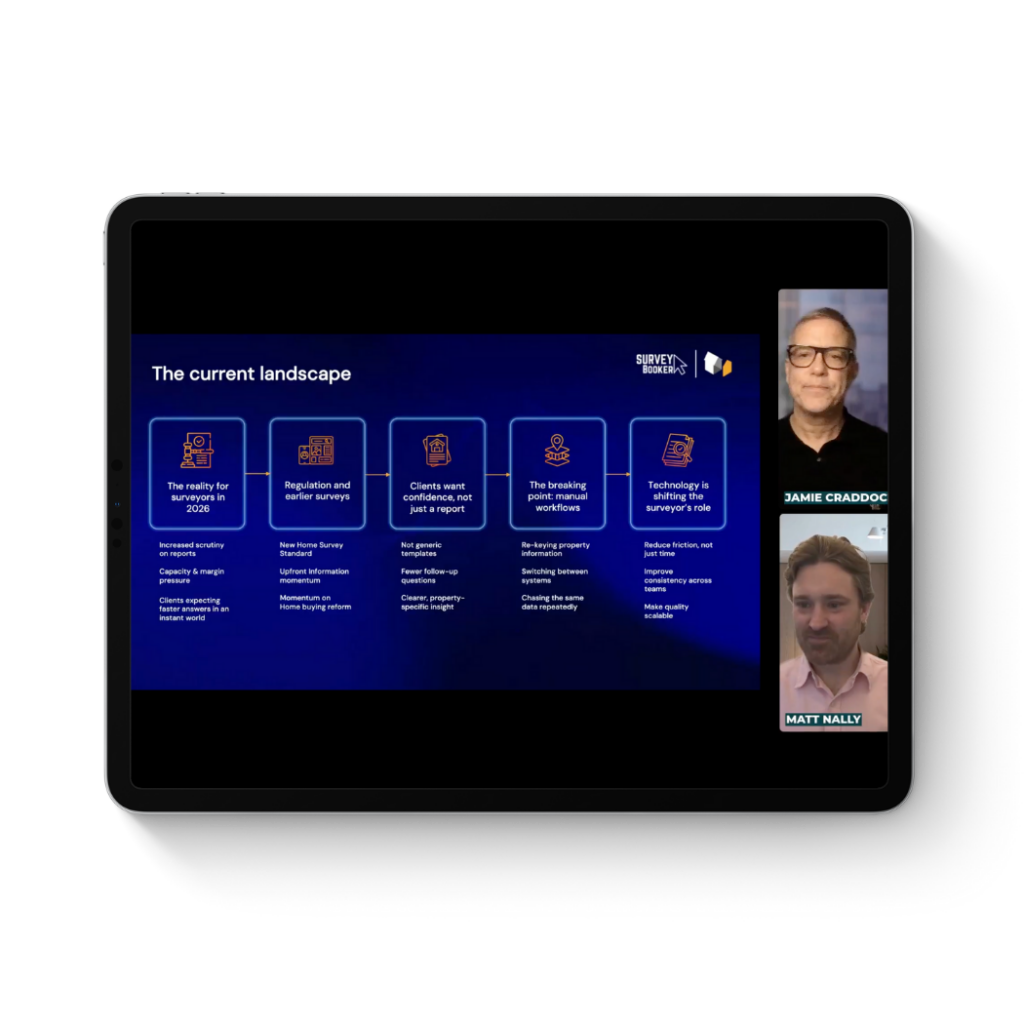
Matt Nally, Founder of Survey Booker, opened the session with a simple but important observation: expectations across the industry are continuing to rise.
Clients increasingly expect faster turnaround times, clearer explanations, and fewer vague caveats. Regulation continues to push for greater consistency, transparency, and evidence. At the same time, buyers are more informed than ever. They research online, use tools like ChatGPT, and arrive with their own questions and assumptions.
For many firms, the challenge is not demand itself, but capacity and consistency. There are only so many hours in a week, and when processes are manual or fragmented, they quickly become the bottleneck.
In today’s market, the firms that thrive are not necessarily the cheapest. They are the ones that work smartest, using technology to remove friction from their workflow and protect time for professional judgement.
Manual Doesn’t Mean Personal
One of the strongest themes from the webinar was the idea that manual work is often mistaken for good service.
In reality, manual workflows often involve re-entering the same data, copying and pasting between systems, chasing emails, and managing admin that adds little real value. This increases the risk of errors and reduces the time available for inspections, analysis, and client communication.
Automation, when done properly, does not remove the human element. It protects it. It removes the repetitive tasks that pull you away from what actually matters: insight, interpretation, and advice.
Technology should handle repetition. Surveyors should handle thinking.
Why Preparation Is Now a Competitive Advantage
Jamie Craddock from Sprift shared insights from their most recent customer survey, conducted in December. One result stood out clearly.
Data accuracy ranked as the number one priority for surveyors.
Above speed. Above volume. Above everything else.
Surveyors told Sprift they would rather wait longer or do more work than rely on data they cannot fully trust. Better preparation means fewer unknowns on site, more focused inspections, fewer post-inspection investigations, and stronger, clearer reports.
Increasingly, that preparation starts before stepping foot on the property. Upfront information supports professional judgement. It does not replace it. It allows surveyors to arrive better informed, ask better questions, and deliver better outcomes.
What Sprift Brings to the Table
Sprift was built to solve a long-standing issue in UK property. Data is scattered, inconsistent, and time-consuming to gather.
Founded in 2016, Sprift aggregates information directly from authoritative sources such as Land Registry and Ordnance Survey, alongside EPC registers, planning data, local authorities, and Historic England. This builds what Sprift describes as a single source of truth for property data across millions of properties.
Since launching dedicated surveyor software in 2022, Sprift has grown from around 100 data points to more than 307 data points across approximately 30.6 million properties, with UPRNs as the primary identifier.
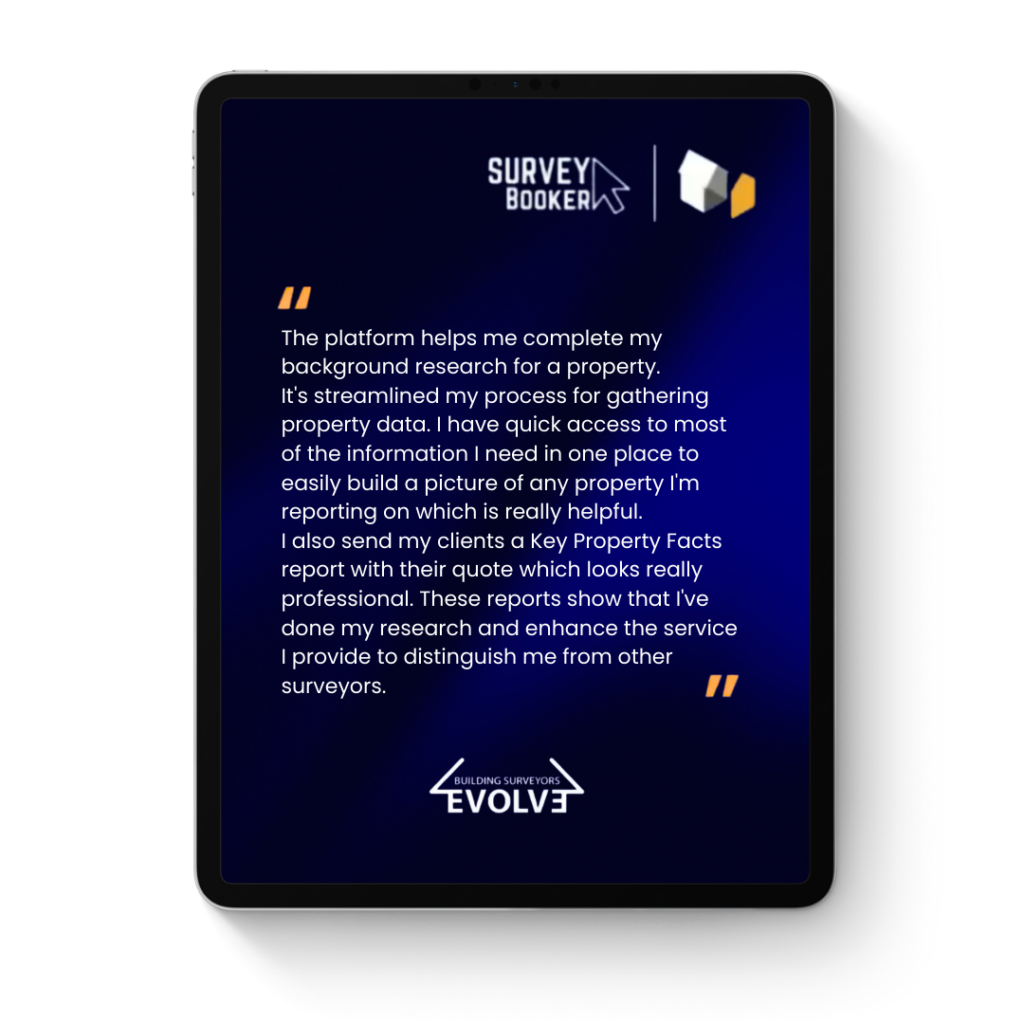
Surveyors use Sprift for desktop research, planning context, historical data, comparables, and tools such as Key Property Facts. This interactive report was developed in response to surveyors asking for something useful they could share at quotation stage to help build trust and improve conversion.
It is not about replacing expertise. It is about starting every job from a stronger, more informed position.
Why the Survey Booker and Sprift Integration Matters
Individually, both platforms are powerful. Together, they remove a significant amount of friction from the survey workflow.
With the integration, property data and reports flow directly into the job record within Survey Booker. Reports can be generated automatically or manually, stored for compliance, attached to emails, and reused throughout the job lifecycle without re-keying or copying and pasting information.
In simple terms, you get better data in the right place, at the right time, with less admin. That leads to greater consistency, fewer errors, and more time for analysis and client communication.
Want to See It in Action?
If you would like to see how the Survey Booker and Sprift integration works in practice, or explore how it could fit into your own workflow, please click here to book a call with our team.
If you are already a Survey Booker or Sprift customer, or you use both and were unable to attend the webinar, you can request to watch it here.
“The Survey Booker and Sprift integration is built around one simple idea: giving surveyors more time to be professionals, and less time to be data collectors.”
“It is not about doing more surveys in less time.It is about doing better surveys, with stronger insight, more confident clients, and less stress behind the scenes.”
The Bigger Picture
This webinar was not really about software. It was about how the role of the surveyor is evolving. The profession is moving away from being judged on how much information is collected, and towards how well that information is interpreted, explained, and used to support better decisions. Clients do not want lengthy reports filled with technical language and generic caveats. They want clarity, context, and confidence.
At the same time, expectations around speed, evidence, and compliance continue to increase. That creates pressure, but it also creates opportunity. Firms that invest in better preparation and smarter workflows are well placed to deliver a higher-quality service at scale, without burning out their teams.
As Matt put it during the session: “The future of surveying isn’t about being faster at typing. It’s about being better at thinking.”
That is exactly where technology should sit. Not replacing professional judgement, but protecting it.