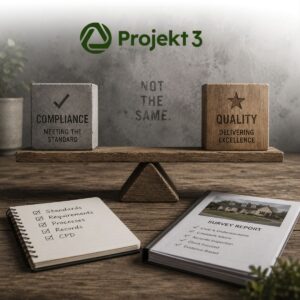
Compliance in Practice
From Conflict Checks to Conflict Management
Putting RICS guidance into practice with robust processes and audit-ready records
Putting RICS guidance into practice with robust processes and audit-ready records
Most surveyors are familiar with the principles surrounding conflicts of interest. The RICS Professional Statement has been in place for several years and is supported by a suite of practical documents covering topics such as identifying conflicts, informed consent and record keeping.
Yet as surveying firms grow, adopt new technologies and manage increasing workloads, the challenge is rarely understanding the principles.
The challenge is applying them consistently.
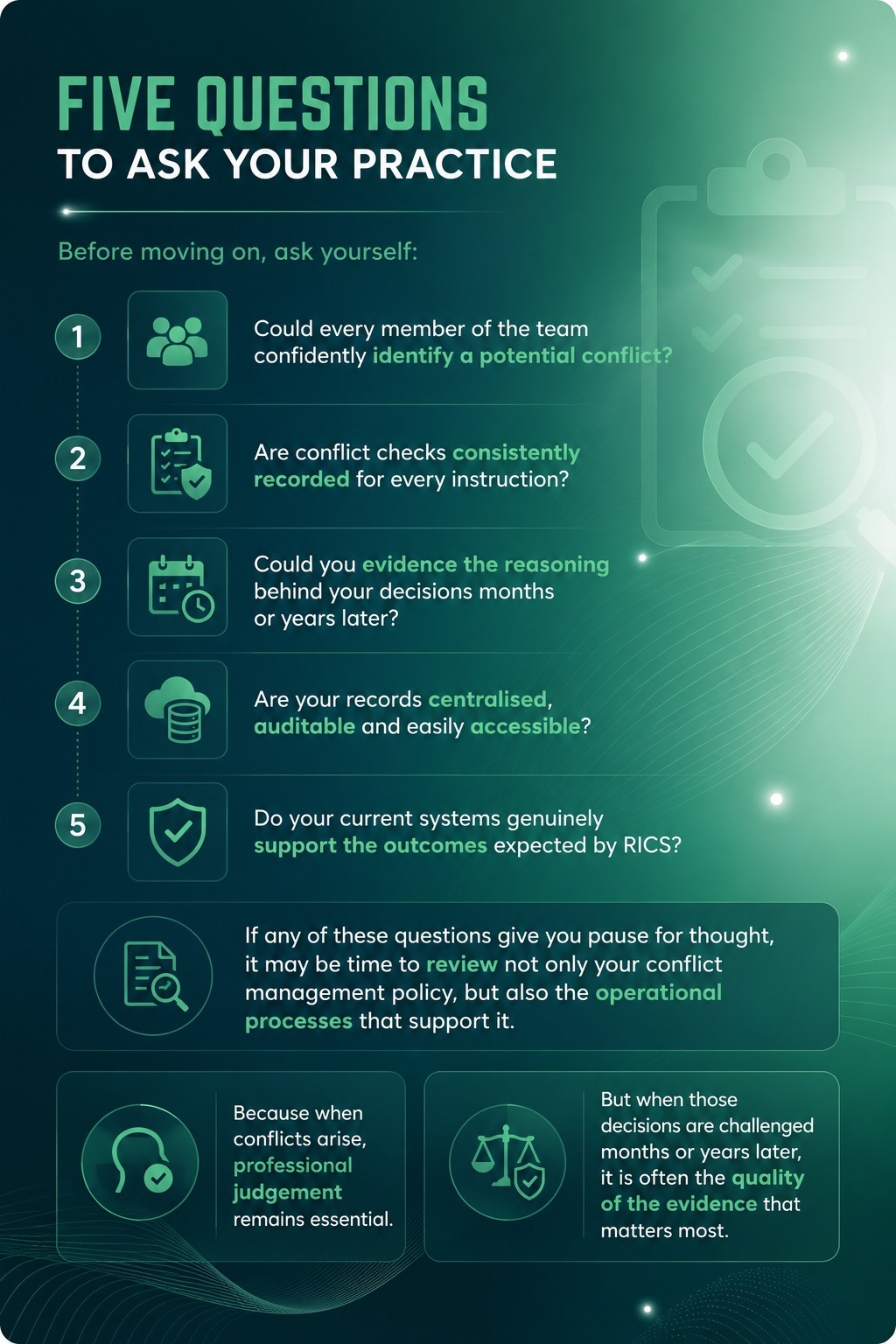
Conflict management is no longer simply about asking whether a conflict exists before accepting an instruction.
It is about creating systems and processes that allow firms to identify potential conflicts, evidence decisions and demonstrate compliance throughout the entire lifecycle of an instruction.
A Timely Opportunity to Review Your Processes
If it has been some time since your practice reviewed its conflict management procedures, now is an ideal opportunity.
Please note: The 1st edition of the RICS Conflicts of Interest Professional Statement is currently being updated. A draft of the 2nd edition is expected to be released for public consultation through the RICS iConsult platform during Q4 2026. Further details are expected to be published by RICS in due course.
Whilst the current Professional Statement remains in force, the forthcoming review provides an excellent opportunity for firms to revisit their own procedures and ensure they continue to reflect current best practice.
What Does RICS Actually Expect?
One of the most useful supporting documents published alongside the Professional Statement is Recording Conflicts of Interest.
Rather than prescribing software or specific ways of working, the guidance focuses on outcomes.
RICS states that regulated firms should maintain records demonstrating both:
Importantly, those records should be created at the outset and throughout the lifetime of an instruction, not simply when questions arise later.
That distinction is significant.
Conflict management is not an event.
It is an ongoing operational process.
From Principles to Practice
The supporting materials published by RICS provide practical examples of both good and poor conflict management.
Examples of good practice include:
Poor practice, by comparison, includes fragmented records, inconsistent updates, incomplete information and a lack of auditable evidence.
Perhaps most importantly, the guidance highlights that firms should maintain records including:
The emphasis throughout is clear.
The objective is not simply identifying conflicts.
It is demonstrating how they were identified, assessed, managed and recorded.

Where Technology Makes the Difference
Technology cannot determine whether a conflict exists.
Professional judgement will always remain essential.
However, technology can make it significantly easier to ensure the information required to exercise that judgement is available at exactly the point it is needed.
It can also ensure that the evidence supporting those decisions is captured naturally as work progresses.
This is where many surveying firms are changing their approach.
Rather than treating conflict checks as a standalone administrative task, they are embedding conflict management into their everyday operational workflows.
Information such as client records, property histories, previous instructions, communications, decision-making notes, informed consent and supporting documents all contribute to a single, auditable instruction record.
Rather than recreating history months later, the audit trail already exists.
"Compliance rarely fails because people don't care. More often, it fails because busy teams are relying on processes that aren't resilient enough to support them under pressure. Good systems don't replace professional judgement, they help protect it."Matt Nally - Director of Survey Booker
Putting Best Practice into Practice
This philosophy has shaped the development of Survey Booker.
Rather than treating compliance as a separate feature, the platform has been designed around the practical outcomes described throughout the RICS guidance.
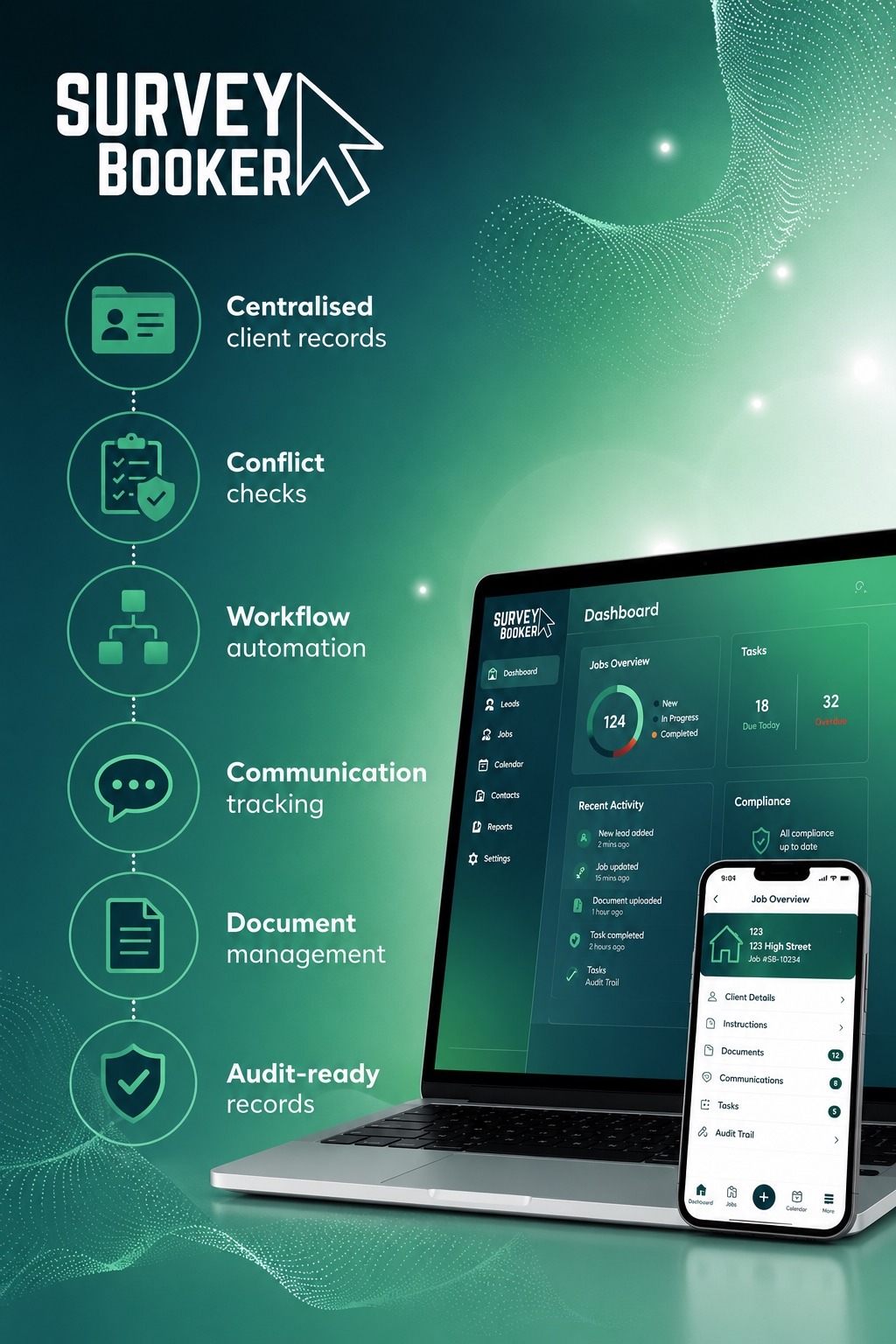
Conflict checking sits alongside centralised client and property records, communication histories, document management, workflow automation, task management and comprehensive audit trails.
The result is that much of the evidence recommended by RICS is created naturally as surveyors and administrators carry out their day-to-day work.
The objective is not to replace professional judgement.
It is to ensure that judgement is supported by accurate information, consistent processes and robust records that can be evidenced whenever required.
Further Reading
If it has been a while since your practice reviewed the RICS guidance, the following documents are well worth revisiting.
Conflicts of Interest: Implementation and Impact (2019). This review examines how the Professional Statement has been implemented across the profession and identifies both successes and common challenges.
Highlights include:
The review found significant variation in how firms identify, manage and record conflicts.
Less formal approaches were associated with weaker record keeping and inconsistent conflict management.
It also outlines the actions RICS has taken to strengthen supporting guidance.
Supporting Guidance
To help firms implement the Professional Statement, RICS has also published three practical supporting documents:
Conflicts of Interest: Implementation and Impact
An industry-wide review exploring how firms have implemented the Professional Statement, identifying common challenges and sharing practical recommendations.
Conflicts of interest: Implementation and impact (PDF 1.35MB)
Identifying Conflicts of Interest
Provides practical examples to help firms identify actual, potential and perceived conflicts before accepting or continuing an instruction.
Identifying conflicts of interest (PDF 0.16MB)
Understanding Informed Consent
Explains when informed consent is required, how it should be obtained and how it should be evidenced.
Understanding informed consent (PDF 1.20MB)
Recording Conflicts of Interest
Offers practical guidance on systems, controls and record keeping, together with examples of both good and poor practice.
Recording conflicts of interest (PDF 0.17MB)
Putting Guidance into Practice
Every surveying practice develops its own way of working. The challenge is ensuring those processes remain consistent, scalable and capable of demonstrating the standards expected by RICS as the business grows.
That’s exactly what Survey Booker was built to support.
Rather than simply digitising administration, Survey Booker brings together client management, workflow automation, communication tracking, document management and audit-ready records within one integrated business management platform designed specifically for surveying firms.
Every enhancement has been developed alongside surveyors with one objective in mind: helping firms embed best practice into their everyday operations. From conflict of interest checks and centralised records to workflow automation and complete audit trails, the platform is designed to support robust processes, strengthen governance and create the evidence needed to demonstrate professional compliance with confidence.
Whether you’re reviewing your current processes, preparing for future regulatory changes or simply looking for a more efficient way to manage your practice, we’d love to show you what’s possible.
Book a discovery call or arrange a personalised demonstration with one of our team and discover how Survey Booker is helping surveying firms turn best practice into everyday practice.